The Government e-Marketplace (GeM) is an online platform where government departments buy products and services from registered sellers. When you participate in bidding on GeM, you often hear terms like L1, L2, and L3. Many new sellers feel confused about these terms, but they are actually simple and very important.
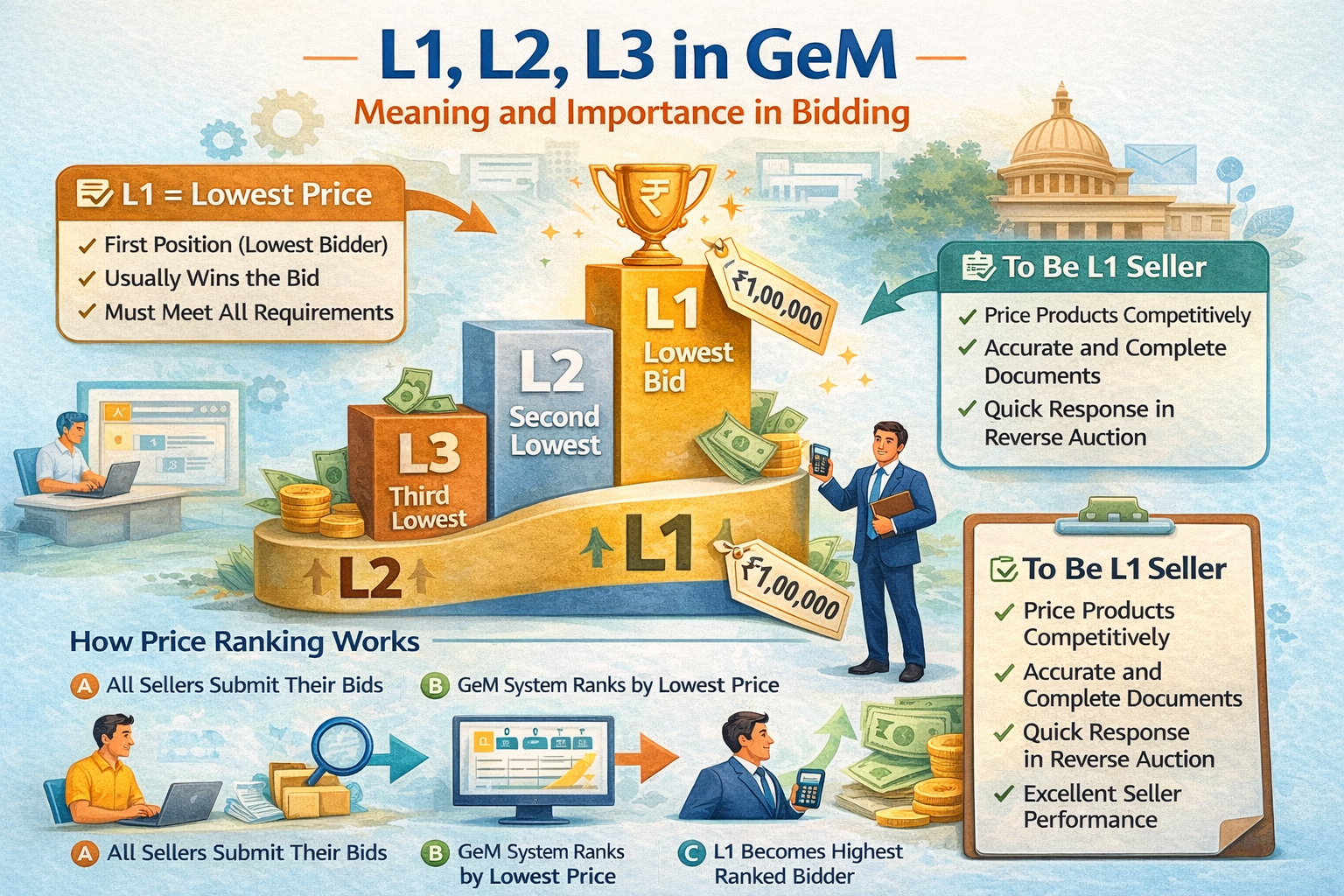
In GeM bidding, L stands for “Lowest”. The numbers (1, 2, 3) show the ranking of sellers based on the price they have quoted in a bid.
-
L1 means the seller who has quoted the lowest price.
-
L2 means the second lowest price.
-
L3 means the third lowest price.
These rankings are automatically decided by the system after all sellers submit their prices.
Why Is L1 Important?
In most GeM tenders, the seller who is L1 and meets all technical and quality requirements wins the bid. This is because government buyers usually select the lowest eligible price to ensure transparency and cost savings.
However, price alone is not enough. The seller must also:
-
Meet all product specifications
-
Submit correct documents
-
Follow delivery timelines
-
Comply with GeM policies
If the L1 seller fails in technical evaluation, the buyer may move to L2.
How L2 and L3 Work
L2 and L3 are backup positions. If L1 is disqualified due to incomplete documents, incorrect details, or failure to meet requirements, the buyer can consider L2. The same process may continue with L3 if needed.
Sometimes, buyers may also negotiate or allow L2 to match the L1 price in certain situations.
Role of Reverse Auction in L1 Ranking
In reverse auctions, sellers compete in real-time by lowering their prices within a fixed time. The seller offering the lowest price at the end of the auction becomes L1.
This process makes bidding more competitive. Sellers must plan their pricing strategy carefully before participating.
How to Improve Your Chances of Becoming L1
Becoming L1 does not mean quoting the lowest price blindly. You need a smart strategy:
-
Calculate your cost properly before bidding.
-
Keep profit margins realistic.
-
Study competitor pricing.
-
Maintain good seller ratings and performance.
-
Ensure all documents are accurate and complete.
If your pricing is too low and you cannot deliver properly, it can harm your business reputation.
Common Mistakes Sellers Make
Many sellers try to become L1 by quoting very low prices without checking their total cost. This can lead to losses. Some sellers also forget to read technical requirements carefully, which leads to disqualification even if they are L1.
Another common mistake is not participating actively in reverse auctions. Delayed responses can push you from L1 to L2 or L3 quickly.
Final Thoughts
Understanding L1, L2, and L3 is very important for success in GeM bidding. These rankings decide your position in the competition and directly affect your chances of winning government orders.
If you plan your pricing carefully, maintain proper documentation, and follow GeM rules, you can improve your chances of becoming L1 and growing your government business successfully.